

Since the start of the armed conflict between Iran, the US and Israel in February 2026, the Islamic Republic’s attacks on the Kurdish population have increased significantly. The escalation of these attacks particularly affects Kurdish women: female fighters from opposition parties in camps in northern Iraq (Bashur), political prisoners in Iranian prisons, and civilians in Rojhilat, the Iranian part of Kurdistan. The pattern is not new, but the war has given it renewed urgency and increased brutality.
Drone strikes on Kurdish camps: Ceasefire without peace
On 8 April 2026, US President Donald Trump announced a two-week ceasefire between Iran and the US and Israel, respectively. For the Kurdish areas in northern Iraq, this ceasefire did not mean peace. Between 14 and 17 April, the Islamic Revolutionary Guard Corps (IRGC) continued its drone strikes on the camps of Kurdish opposition parties in the Kurdistan Region (KRG).
On 14 April, Xezal Mewlan (Ghazal Molan Cheparabad), a 19-year-old Peshmerga fighter with the Komala Party of Iranian Kurdistan, was seriously injured in an IRGC drone strike on a residential complex in the Surdash camp area in Sulaymaniyah Governorate. What followed was not a coincidence, but a convergence of military and institutional failure with fatal consequences.

Her fellow fighters first took her to the nearby Shorsh Hospital, which did not have sufficient medical capacity. She was then transferred to Bakhshin Hospital in Sulaymaniyah. There, the hospital management refused to admit her, fearing reprisals for treating a Peshmerga fighter who was fighting the Islamic Republic. According to eyewitness and Komala activist Shakila Mahdipanah, who accompanied Xezal Mewlan, hospital staff resisted all pleas for admission for 45 minutes despite her rapidly deteriorating condition and heavy bleeding. “We had no choice but to take her somewhere else,” Mahdipanah told The Media Line. Xezal Mewlan succumbed to her injuries on 15 April.
The human rights organisation HANA is investigating the case and has received serious allegations that she was neither provided with advanced imaging nor specialised trauma care and intensive care, and that a timely transfer to a suitable facility was not possible. The Independent Human Rights Commission of the Kurdistan Region expressed deep concern over her death, and the KRG Ministry of Health launched a formal investigation and described the refusals by hospitals as unacceptable. Even after her death, Xezal Mewlan was denied dignity: local mosques refused to perform the Islamic washing ritual, and public cemeteries initially refused burial. She was ultimately buried in the private garden of Kurdish politician Sardar Abdullah.

On 17 April, further IRGC drone strikes on a camp of the Democratic Party of Iranian Kurdistan (PDKI) near Erbil killed two more Peshmerga fighters: Nada Miri and Samira Allahyari. The same attack also killed Shahin Azar Barzin, while his father was seriously injured.
The scale of these attacks is considerable. Between 28 February and 15 April 2026, a total of 703 drones and rockets were fired at the Kurdistan Region, killing 17 people and injuring 92. Estimates suggest that around 18% of these attacks were directed at camps of Kurdish opposition parties, where civilians and families also lived. In an attack on 24 March, six Peshmerga members were killed by an IRGC drone.
Notably, these attacks occurred at a time when neither the KRG government nor the Iranian Kurdish parties were conducting military operations against the Islamic Republic. Reports by international media claiming otherwise were explicitly rejected by the Kurdish parties.
Death sentences against Kurdish women: Activism as “armed rebellion”
In parallel with attacks beyond its borders, Iran continues its policy of criminalising Kurdish women at home. Pakhshan Azizi, a Kurdish social worker and human rights defender from Mahabad, has been held in Tehran’s Evin Prison since August 2023. In July 2024, a Revolutionary Court sentenced her to death for “armed rebellion against the state”, solely on the basis of her humanitarian work in refugee camps in north-eastern Syria and Sinjar, where between 2014 and 2022 she supported women and children affected by ISIS attacks.
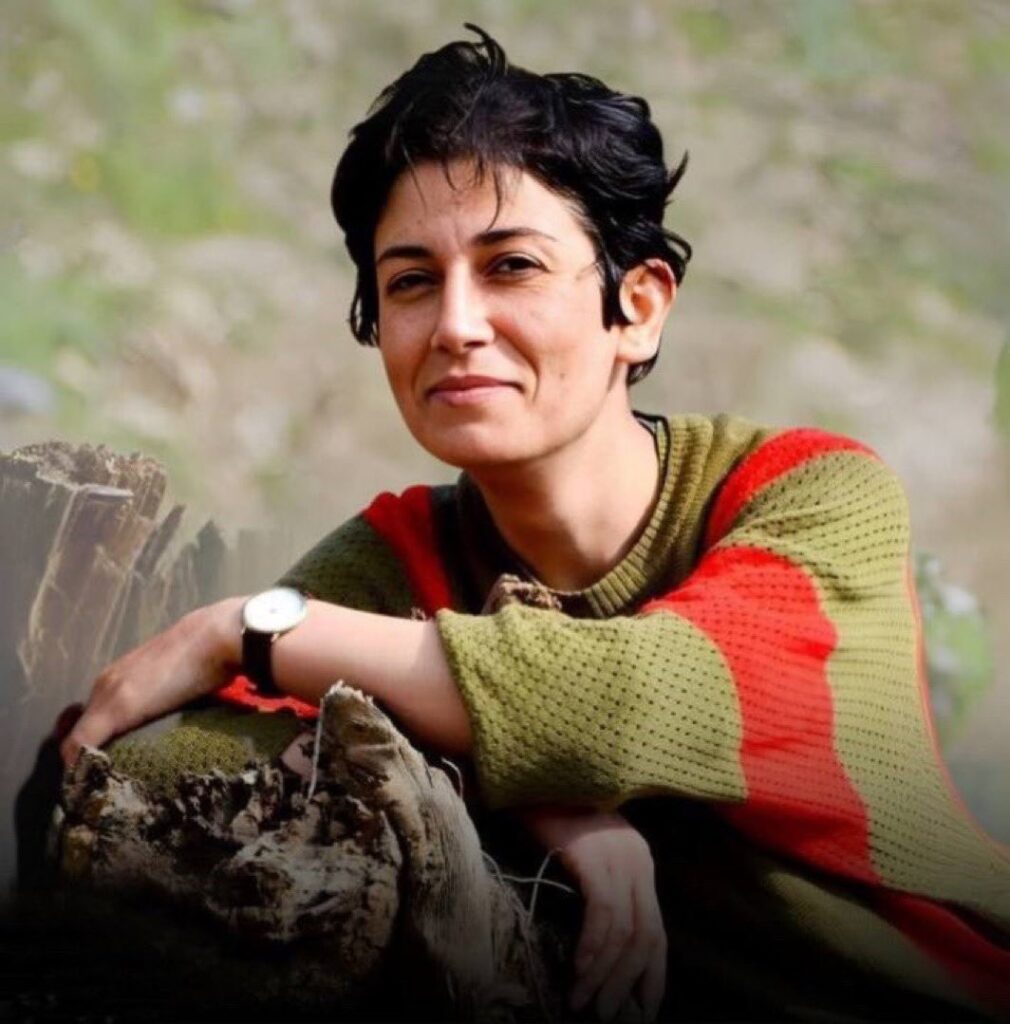
In January 2025, the Supreme Court upheld the death sentence; in April 2026, a second request for judicial review was also rejected. Azizi’s lawyer strongly criticised the proceedings: procedural violations had been ignored, and the peaceful nature of her work had played no role in the verdict. Amnesty International described the case as arbitrary detention and called for her immediate release.
During the same period, Varisheh Moradi, a Kurdish woman who had fought ISIS in Kobane, was also sentenced to death by Tehran’s Revolutionary Court, likewise on the grounds of “armed rebellion”. In January 2025, six Kurdish parties called for a general strike to prevent the executions. Kurdish cities such as Sanandaj, Saqqez, Mahabad and Marivan largely took part in the strike, which was also supported by Iranian intellectuals, women activists and trade unions.
Political prisoners at risk of death: Zeyneb Celaliyan and others
On 22 April 2026, the news platform Dengê Binçavkiriyên Kurd û Îranî reported that the health of four political prisoners in Iran’s Yezid Prison has deteriorated significantly. Among them is Zeyneb Celaliyan, Iran’s longest-imprisoned female political prisoner. Celaliyan has been in prison since 2007 and has struggled with serious illnesses for years. According to the report, she and her fellow inmates Perisa Kemali, Dr Hamid Qarehhasanlou and Hojjat Alizadegan are being denied access to medical treatment.

In addition, the prisoners have been cut off from contact with their families, security pressure has been increased, and the procedural status of some of their cases has been left in an unclear state under the pretext of missing documents, further endangering them.
Domestic repression: Arrests and communications disruptions
With the escalation of the war, the Islamic Republic has also intensified domestic repression. Reports document a sharply increased number of arbitrary arrests of civilians and women political activists in Rojhilat. The Kurdistan Human Rights Network recorded a heightened pattern of targeted arrests and intimidation of Kurdish civil society during phases of military escalation. Women who are already on the authorities’ radar because of their political activities are particularly at risk.
At the same time, Iran’s internet blackout surpassed 1,000 hours. This shutdown serves not only to suppress protest, but also to make it more difficult to document state violence in Kurdistan. Reports of ill-treatment, arrests and attacks can therefore scarcely reach the outside world.
Triple marginalisation: Structural context
Kurdish women in Iran are subject to triple marginalisation: as women under a theocratic regime that deprives them of fundamental rights, as members of an ethnic minority in a Persian-centred nation-state, and as individuals within patriarchal social structures. Statistically, compared with Persian women, Kurdish women in Iran face higher imprisonment rates and more intense persecution by the authorities.
Kurdish areas in Iran have been subjected for decades to systematic economic neglect and military penetration. Access to education, employment and public office is structurally restricted for Kurds. Persian remains the only language of instruction in schools, disadvantaging Kurdish children from the outset.
Shortly after the 1979 revolution, Ayatollah Khomeini declared jihad against Kurdistan and authorised large-scale military operations that led to massacres, executions and displacement. The Islamic Republic continues this practice of criminalising Kurdish political existence as a threat to the state to this day, now under the pretext of a state of war and security interests.
For Kurdish women in exile in the Kurdistan Region or in Europe, this means that returning to Iran is not a realistic option even after a possible end to the war. A Kurdish woman living in Erbil told the media outlet The Amargi that change might come more quickly in Kurdish areas because there is greater social support for women’s rights there. However, the structures of the regime and society cannot be changed by war alone.
Context
The attacks on Kurdish women—whether through drones on Peshmerga camps in Bashur, through death sentences against women activists in Iranian prisons, or through the systematic denial of medical care for political prisoners—follow a coherent logic. The Islamic Republic views the Kurdish freedom movement as an existential threat. The fact that women play a central role in this movement makes them a preferred target of this policy.
The war did not create this pattern, but it has provided it with new means and a new basis for legitimisation. Ceasefire or not: the shelling in Kurdistan has not stopped.
Sources: The Amargi, NCRI Women’s Committee, Amnesty International, Hengaw Organisation for Human Rights, Kurdistan Human Rights Network, Dengê Binçavkiriyên Kurd û Îranî, KJK statement (April 2026), Channel 8, Rudaw, JIN TV, Rojhelat Info