
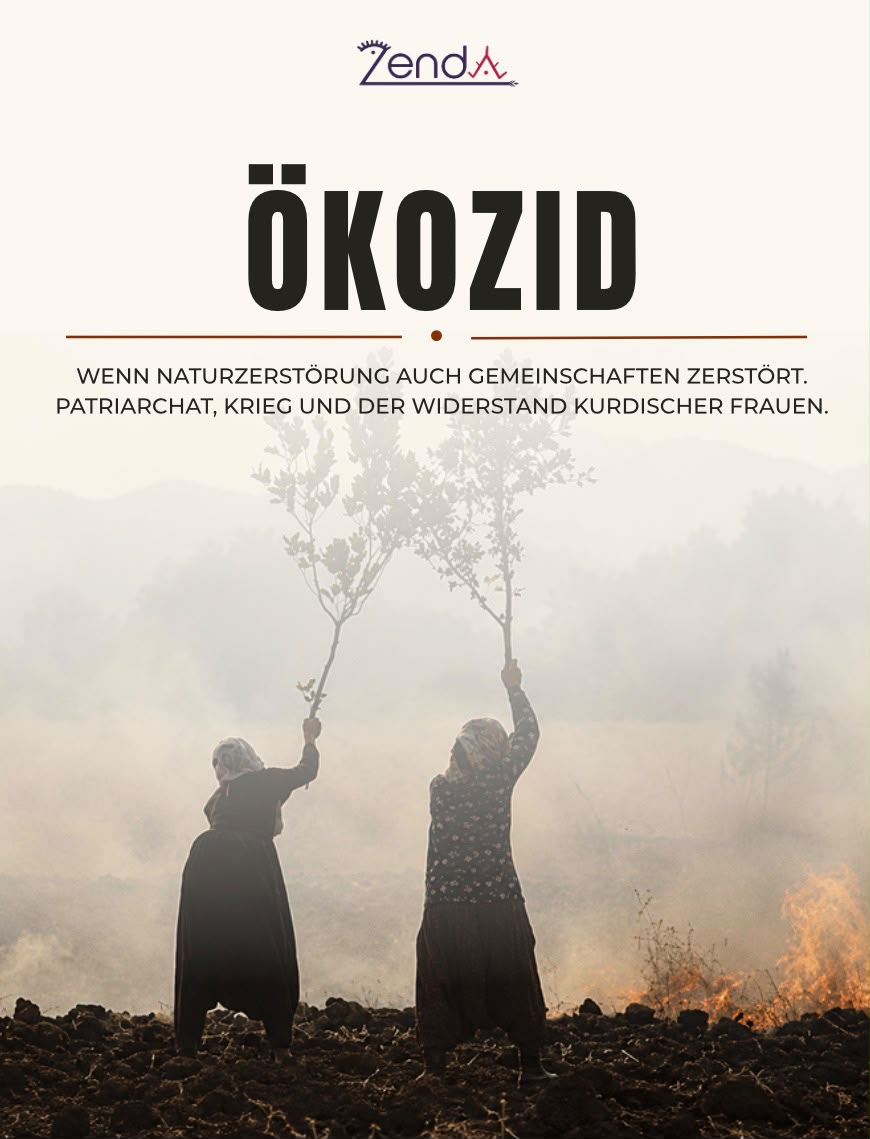
When a forest disappears, it is not only a collection of trees that dies. With it, memories, knowledge, ways of life and the livelihoods of entire communities disappear. This is precisely the kind of destruction that many activists in Kurdistan describe as ecocide.
When people speak of ecocide, it is not only about the destruction of forests, rivers or soils. The term describes the systematic annihilation of livelihoods—a form of violence against nature that also has social, cultural and political consequences. This is particularly evident in Kurdistan, where ecological destruction is closely linked to decades of oppression, war, dispossession and the exploitation of natural resources.
The history of Kurdistan shows that the destruction of nature does not happen by chance. Traditional agriculture, local seed systems and communally organised forms of economy have in many places been displaced by industrial agriculture, monocultures, the use of chemical inputs and capitalist economic models. The consequences are depleted soils, a decline in biodiversity, water scarcity, and growing dependence on corporations and state structures.
Patriarchal systems rely on exploitative mechanisms to maintain the oppression of women and thus their domination. This creates social structures that present this condition as natural, inevitable and acceptable. A similar logic can be seen in the exploitation and destruction of nature: in the clearing of ancient forests, the poisoning of waterways, destruction caused by human-induced forest fires, and the exploitation of natural resources for the benefit of capitalist growth and the maintenance of nation-state hegemony. In the process, human beings become alienated from earth, air, water and plants. They no longer understand themselves as part of nature, but confront it as rulers and owners.
From this perspective, ecocide is not merely the destruction of nature. It is also an attack on communities and cultural knowledge, and it prevents the possibility of making self-determined decisions about food, water and land.
Kurdistan is undergoing profound social change. Urbanisation is increasingly replacing the habitats of mountains, rivers, forests and caves that have accompanied Kurdish communities for generations in their resistance against occupying and colonial states. A society with a strong ecological awareness and a rich wealth of experience in dealing with natural livelihoods now faces a fundamental contradiction. War and state violence contribute to the weakening of society’s bond with nature. As a result, a collective culture of remembrance of local ecosystems—which ensured sustenance and survival over generations—is increasingly at risk.
Why women feel ecocide first
Those most affected are people whose lives have been closely tied to the land for generations. Kurdish women have traditionally played a central role in preserving seeds, ecological knowledge and communal systems of provision. With the destruction of local ecosystems, therefore, not only nature is lost, but also a collective memory that has been passed down through generations. Many Kurdish activists therefore understand the struggle against ecocide as simultaneously a struggle against patriarchal, colonial and capitalist relations of domination.
When a river dries up, a forest is cleared, or soil is poisoned by pesticides, the consequences are rarely felt equally by everyone. In many parts of the world—and especially in Kurdistan—women are among the first to experience the effects of ecological destruction. This is not because women are “by nature” closer to nature, but because they have historically taken on central tasks in sustaining life: as farmers, seed keepers, providers for their communities, and bearers of knowledge about land, water and food.
Over generations, women collected, stored and preserved seeds and passed on their knowledge. They knew which plants thrive under which conditions, how soils can be protected and harvests secured. This knowledge did not emerge in research institutions, but in the everyday life of communal living. When an ecosystem is destroyed, therefore, it is not only nature that is lost. A treasure of knowledge built up over centuries disappears as well.
What is particularly affected is women’s world of knowledge and experience. Similar to ecological resources, female bodies and experiences are objectified in order to institutionalise patriarchal rule. The connection to nature is weakened, while women’s survival becomes increasingly tied to systems that push them into passive roles and at the same time deprive them of their worlds of experience. This process follows a strategic logic: nature and women are not only alienated from one another, but also from the social contexts in which they live. Patriarchy thus determines how social relationships are shaped and how people interact with their natural environment.
Many Kurdish women’s movements see this as far more than an ecological crisis. They understand the attack on nature as an attack on social relationships at the same time. From their perspective, the destruction of ecosystems is based on the same logic that seeks to control and dominate women, communities and cultural knowledge. The exploitation of nature thus does not appear as an isolated environmental problem, but as part of a broader system of power and domination.
Resistance as the defence of life
For precisely this reason, the resistance of Kurdish women is not limited to protest. In numerous regions, women organise cooperatives, establish local seed banks, promote agroecological farming and defend traditional forms of food production. They fight for food sovereignty—that is, for the right of communities to decide for themselves how food is produced, distributed and consumed. Reviving local seed varieties thus becomes an act of self-determination. Caring for the soil becomes a form of political action.
These initiatives do not pursue the goal of curbing environmental destruction alone. Rather, they represent a fundamental alternative to a system that primarily views nature as a resource. Instead of competition, they rely on cooperation; instead of exploitation, on care; and instead of dependence, on communal self-organisation. In this sense, Kurdish women do not only defend forests, water or soils. They defend the possibility of a different relationship with nature—a relationship based on responsibility, reciprocity and the protection of life.
Ecological resistance is closely linked to the defence of the land and extends from Kurdistan to the struggles of Indigenous communities worldwide who are threatened by nation-state and imperial projects. The mobilisation of women in resistance arises both from political necessity and from a deep connection to the land—a relationship that occupying states do not possess.
In Palestine, for example, olive trees are destroyed—trees that have been closely linked to the history and identity of the Palestinian people for centuries. There, too, women resist this policy of destruction with body and mind. In Abya Yala, peasant women organise social structures and act as central actors in the struggle against transnational corporations. In India, women are engaged against the ecological and social consequences of major dam projects and against state-driven displacement. In Kurdistan, women organise as an act of solidarity against patriarchal violence and develop ecological and grassroots-democratic systems to rebuild local resources and strengthen the bond with nature.
Thus, women are not only those who experience the consequences of ecocide particularly early. They are also among the most important actors in the struggle against it. Their resistance shows that defending nature is always also defending knowledge, community and social freedom—and that these cannot be separated from one another.